
-
Who This Checklist Is For
-
Step 1: Lock Down Your Specs Before You Talk Price
-
Step 2: Demand Original Manufacturer Authorization
-
Step 3: Request a Written Wiring Diagram for Branded SKUs
-
Step 4: Calculate Total Cost of Ownership, Not Unit Price
-
Step 5: Evaluate Protector Manufacturers Systematically
-
Step 6: Analyze Transfer Switch Wholesale Terms
-
Step 7: Verify Certifications and Compliance Documents Online
-
Step 8: Run a Small Test Order Before Committing
-
What to Watch Out For
Who This Checklist Is For
If you're buying electrical components in bulk for a facility, a contracting business, or a distribution channel, this list is for you. I'm a procurement manager at a 140-person electrical contracting company. I manage roughly $1.2M in annual component spending. Over the past seven years, I've negotiated with 30+ vendors and logged every single invoice in our cost tracking system.
This is the actual process I run every time I evaluate a new supplier — not a theoretical framework. I've compressed it into 8 steps. Work through them in order, and you'll avoid most of the traps that turn a "cheap" quote into a 20–35% overrun.
Step 1: Lock Down Your Specs Before You Talk Price
Most buyers open with "What's your price?" That's backwards. You need to confirm specs first. For switches and outlets, that means: amperage rating, voltage, pole configuration, terminal type, and whether tamper-resistant (TR) construction is required.
Since the 2008 National Electrical Code (NEC 406.11), tamper-resistant receptacles are required in dwelling units. If you're sourcing Leviton switch and tamper resistant outlet combinations in bulk, confirm the TR rating in writing. Some suppliers will quietly substitute standard models to hit a lower price point.
Fuse specifications get technical fast. You need to confirm: current rating, voltage rating, interrupting rating (AIC), time-current characteristics, and standard dimensions (e.g., Class CC, Class J, Class RK5). I've seen fuses quoted at half the expected price because the interrupting rating was 10kA instead of the 200kA the application required. That's not a deal — that's a liability.
For transfer switches, nail down whether you need manual or automatic, the amperage, the number of poles, and whether service-entrance rated equipment is required.
Here's where I got burned early in my career. In 2022, we were sourcing for a warehouse project. Vendor A quoted us $1,840 less than Vendor B on a fuse order. The catch? The interrupting rating was 10kA versus the 200kA our spec required. We caught it during receiving inspection. Had we not, that entire shipment would have been non-compliant and unreturnable.
Step 2: Demand Original Manufacturer Authorization
This is the step most buyers skip. If you're sourcing Leviton switches, ask for proof of authorized distribution. Unauthorized resellers may be selling gray-market product with no manufacturer warranty and no access to technical support.
"We sell genuine products" is not the same as "we're an authorized distributor." Ask for a copy of their authorization letter or distributor agreement. Then, verify it. A 10-minute call to Leviton's distributor support line can confirm whether a supplier is actually authorized.
If the supplier is selling their own or a third-party brand, ask for test certification documents. UL listings are verifiable online — use UL Product iQ to confirm the listing yourself. Don't take a PDF at face value.
Step 3: Request a Written Wiring Diagram for Branded SKUs
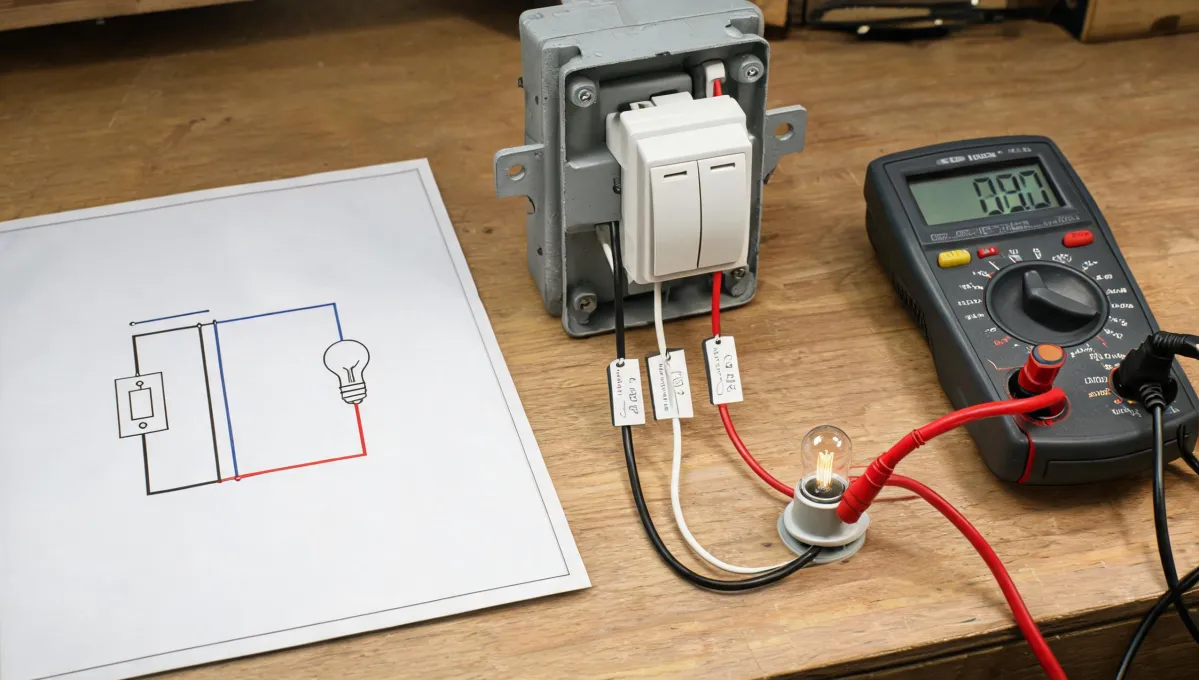
If your electricians need a Leviton switch wiring diagram, don't guess. Ask the supplier to include factory documentation for the specific model number. Switch configurations vary — especially for 3-way and 4-way switches — and a generic diagram can lead to miswiring, callbacks, and liability.
There's a detail here that I missed the first time: some distributors will send a generic wiring diagram as part of the order documentation. The Leviton switch wiring diagram needs to match the exact SKU you receive. Ask the supplier to confirm the diagram corresponds to the shipped model. If they can't, request it before signing off on the order.
Step 4: Calculate Total Cost of Ownership, Not Unit Price
This is where the transparency principle actually pays off. The quoted unit price is the easiest number to see, but it's rarely the final cost.
You need to calculate: unit price × quantity + shipping + liftgate/delivery surcharges + rush fees (if needed) + return/replacement costs + payment processing fees + storage costs if delivery timing is off.
Here's a real example. In 2023, we compared two transfer switch wholesale suppliers. Vendor A: $340 per switch, freight included. Vendor B: $310 per switch, but charged $45 per unit freight, 2% payment processing, $75 for orders under 10 units, and a $25 expedite fee if the order shipped within 10 days of quote. On a 20-unit order, Vendor B's landed cost was 12% higher than Vendor A's.
Our procurement policy now requires a landed-cost spreadsheet comparison from at least three vendors on any order over $5,000.
Step 5: Evaluate Protector Manufacturers Systematically
If you're evaluating surge protective device (SPD) or voltage protector manufacturers, don't just look at spec sheets and price. Check these five things:
- Do they manufacture or private-label? (Ask for the factory address.)
- Is the product UL 1449 listed? (Verify at the model level, not brand level.)
- Do they publish surge current ratings, clamping voltage, and response time?
- Is the warranty clearly stated with replacement policy and turnaround time?
- Can they provide references from buyers in your segment or application?
Most buyers focus on price per unit and completely miss response time. A protector with a 5-nanosecond response time versus one with a 1-nanosecond response time can mean the difference in protecting sensitive equipment — and the material cost difference between them is often minimal.
Step 6: Analyze Transfer Switch Wholesale Terms
When buying transfer switches wholesale, terms matter as much as the product. Confirm:
- Are shipments palletized or individual?
- What are the price breaks at 10, 50, and 200 units?
- What's the policy on quantity changes mid-project?
- Are there storage or consignment options?
- What's the lead time, and what happens if they miss it?
One thing I learned: never accept a "project-based" locked quote on your first order. Ask for a clear price ladder by volume, and indicate that you expect terms to be renegotiable if volume increases.
Step 7: Verify Certifications and Compliance Documents Online
Don't accept a PDF certificate as proof. Verify at the source. UL listings, CSA certifications, and ETL marks are all searchable. For protective devices, you may also need NSF or healthcare-related certifications, depending on the application.
Here's an important clarification: a supplier having a UL certification on file does not mean the specific model you're buying is covered. Certifications are model-specific. Request the certificate that covers your ordered model, and note the UL file number for your records.
My team now has a checklist: every shipment must include compliance documentation, and we verify the certificate against the manufacturer's online database each time.
Step 8: Run a Small Test Order Before Committing
Don't place a full year's budget with an unproven supplier. Start with a small, acceptable order — maybe 10% of your typical volume. Test their order accuracy, packaging quality, lead time, and invoice accuracy.
I use this approach to catch fee creep. One fuse supplier we tested added a 1.2% "fuel surcharge" on every invoice that was never mentioned in the quote. On a small test order, that's $40. On a full year's commitment, it would have been thousands. Small test orders reveal what the quote didn't say.
What to Watch Out For
A few things I've learned the hard way:
- Beware of "free shipping" promises. Get it on the quote or it doesn't exist.
- Don't consolidate all orders with one vendor. Even a great supplier can have a bad quarter. You need a backup.
- Watch for too-good-to-be-true pricing. A switch priced 30% below market is either a substitute or a counterfeit.
- Check return policies. Electrical components are often non-returnable once installed. Clarify defect handling before you buy.
- Re-verify certifications periodically. Standards update. Certificates expire. Your approved vendor list should not be static.
This process isn't bulletproof. My experience is mostly domestic suppliers and mid-volume electrical projects. If you're sourcing highly custom switchgear or international product, some steps may need adjustment. Also, these price points and standards reflect late 2024 / early 2025. The NEC updates on a three-year cycle, and manufacturer certifications change. Verify current requirements before you commit.
But if you're like me — trying to get the true best total cost on electrical components, not just the flashiest unit price — these eight steps will get you there.