
The problem nobody warned me about
I've been managing facilities purchasing for four years now. Before that, I was the person ordering paper, pens, and coffee. Now I handle sewage pump control panels, home lighting control panels, and PLC modules with budgets that could buy a decent used car.
Let me put it plainly: nobody told me that learning Omron PLC procurement from scratch would feel like this.
On the surface, the problem looks simple. Engineering sends a request. The request has a part number. I get quotes from three vendors, compare the numbers, and place the order. Sometimes the thing fits. Sometimes it doesn't.
But what took me over a year to figure out is that the real problem isn't the vendor, the price, or even the parts themselves.
What I was actually getting wrong
Engineering and purchasing speak different languages
This was the first trap.
The first time I received a request, it read: "Need 2x Omron NX PLC digital input modules."
I thought: great, Omron PLC, got it. I googled it, found a list of part numbers, picked one that seemed to match "Omron PLC" and "digital input," and ordered.
What arrived was a CPM2C-series expansion module.
You're probably laughing. I wasn't.
Honestly, I'm still not entirely sure why CPM2C and NX expansion modules aren't interchangeable—they look nearly identical to the naked eye. My best guess is it comes down to backplane protocol differences. Instead of explaining, our facilities supervisor just sighed when I called him.
Most buyers focus on per-unit pricing and part numbers. They completely miss series compatibility—the thing that actually determines whether the part will work.
The question everyone asks is "what does it cost?" The question they should ask is "which series does this belong to?"
The legacy problem that costs real money
Here's the thing. We have two facilities in our building—one from 2008 running CPM2C series equipment, and one from 2022 running the Omron NX PLC platform. Both are stable. No complaints.
The issue: our maintenance team is so used to sourcing CPM2C parts that when someone writes "Omron PLC module" on a procurement request, the new guy defaults to CPM2C. The part arrives. It doesn't fit the NX chassis.
Never expected this to be the problem. Turns out it wasn't the parts themselves—it was the two-year period where neither side said anything because engineering assumed purchasing "should know" and purchasing assumed engineering would "write it clearly."
The 'local vendor is always easier' thinking comes from an era before online part catalogs and cross-reference tools. Today, a well-organized distributor portal can often beat a disorganized local counter—especially for legacy series like CPM2C where local stock is thin.
The application blindspot
In our procurement system, a sewage pump control panel and a home lighting control panel can both be tagged simply as "PLC accessories." But their redundancy requirements, environmental ratings, and fail-safe expectations are completely different.
I don't need to be an engineer. But as the buyer, I should at least know when to ask questions instead of clicking "order."
The basic skill nobody formally taught me
Then there's the maintenance side.
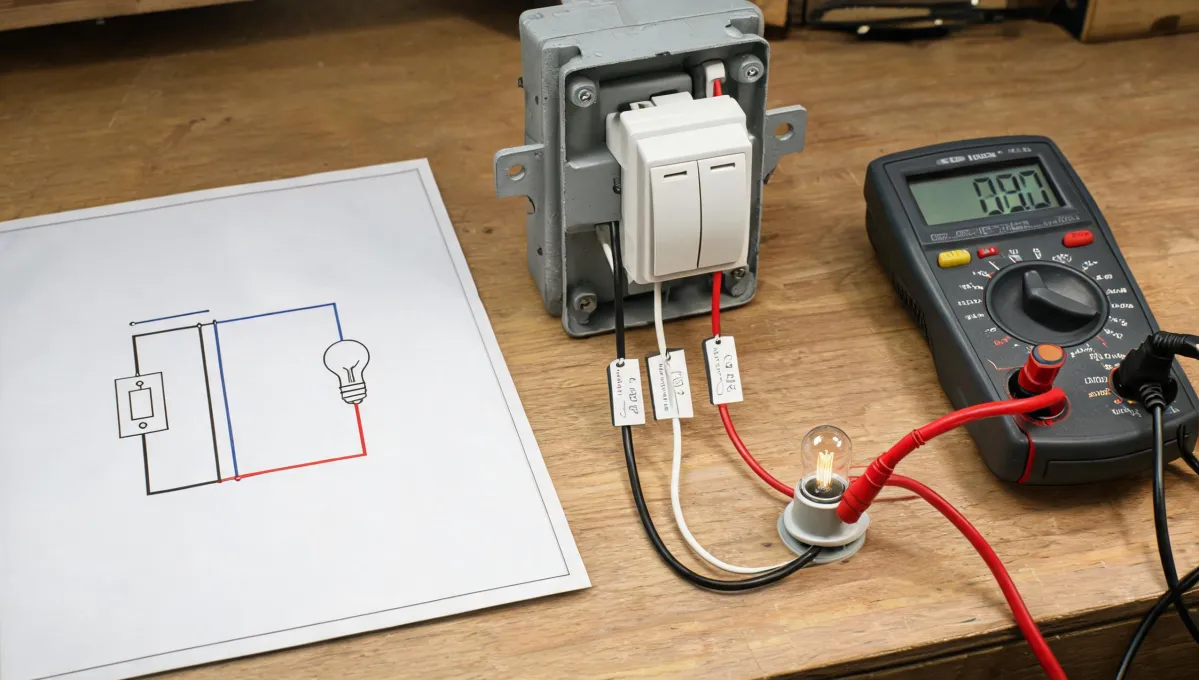
One of our pump control panels flagged a fault. The engineer said: "Grab your multimeter and test the resistance—see if it's a wiring issue or a module issue."
I thought: use a multimeter… to test resistance… how?
It took me twenty minutes to figure out how to test resistance and what a normal reading should look like. Not complicated. But someone should have taught me.
Eventually I realized: for anyone managing facilities procurement, knowing how to test resistance with a multimeter is actually worth the twenty minutes. It tells you whether to call a supplier or call maintenance.
What this cost us
Let me do the math.
- Wasted CPM2C modules sitting on a shelf. Three units, roughly $680 total. Past return window.
- Restocking fees from two vendors—15% per return. Sounds small until you multiply it by six incidents per year.
- The biggest cost: downtime. One of our sewage pump control panels sat dead for nearly two days while engineering waited for the correct NX module because purchasing had ordered CPM2C-compatible parts.
- My credibility. Engineering didn't yell at me. But I got a lot of "can you confirm with us first next time?" for several weeks.
On the finance side, they saw the restocking fees. On the operations side, they saw the downtime. I had to explain both.
What finally worked
This part is short—because if you've read this far, you already know what the problem is.
Make "series" a required field. Every PLC procurement request now specifies the series: CPM2C, NX, NJ, CP1L, etc. One change eliminated over 80% of our mis-orders.
That's it. That's the whole fix. Simple, but it felt like a genuine win after eight months of guessing.
Build a cross-reference sheet. We created an internal reference that maps each Omron PLC series to compatible expansion modules, cable types, and typical applications—sewage pump control panels, home lighting control panels, whatever the case may be. Not official documentation. Just a team resource. It works.
Learn basic diagnostics. If you're buying for facilities and you don't know how to test resistance with a multimeter, spend the twenty minutes. It helps you distinguish between a wiring problem and a module problem—which tells you whether to call the vendor or call the technician.
Establish a weekly check-in. We now do a 15-minute call every Friday. Not to solve every issue—just to confirm next week's procurement needs and series requirements.
Final note
Five years ago, CPM2C series was the standard. Today, the Omron NX PLC platform is what most new installations use. Ten years ago, a purchasing administrator didn't need to know the difference. Today, not knowing can cost you thousands in parts that physically will not fit.
The fundamentals haven't changed: clarify the requirement, write it down, confirm the spec. But the execution has transformed.
That's how the industry evolves. Not with a bang—but with a required field in the procurement form.