
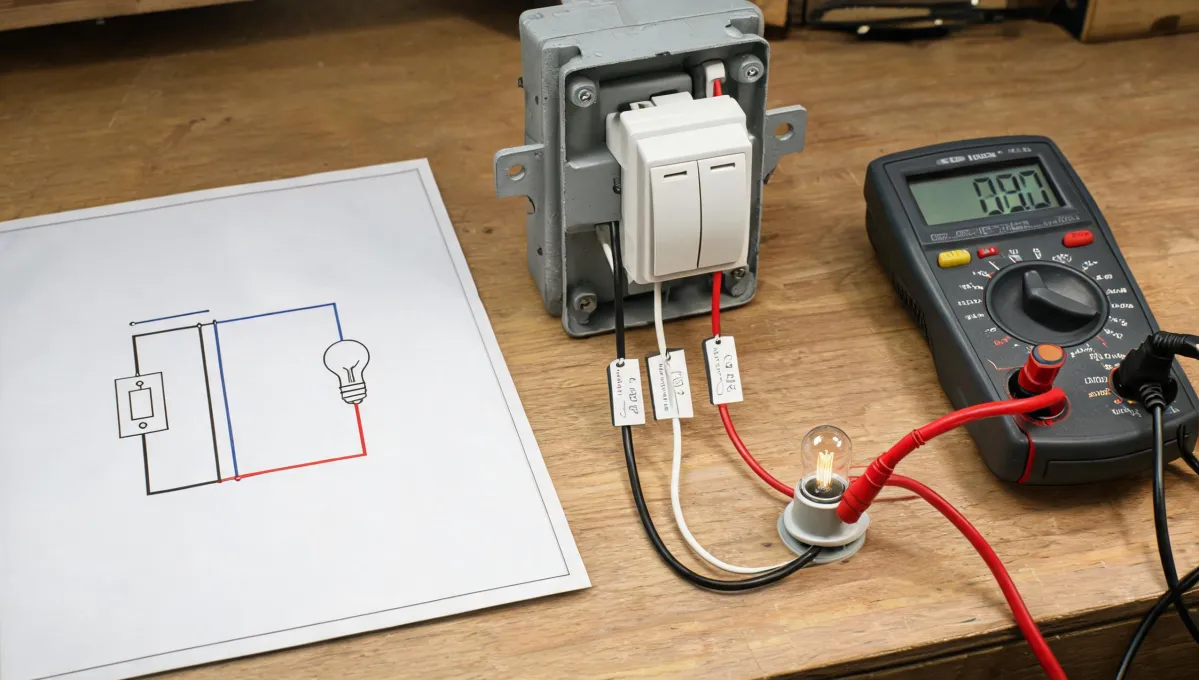
In my opinion, most wholesale buyers ask the wrong question when they start with a Leviton switch. They ask about price before they ask about specification. I've been managing electrical supply purchases for our company for a little over five years—roughly $400k a year across 60–80 orders—and the most expensive mistake I ever made wasn't a part that failed. It was paperwork that didn't match the part. So let me say this clearly: The best Leviton switch is the one you can prove is the right product for the job.
If you're buying Leviton switches and outlets wholesale, don't start with the price. Start with the code requirement, the catalog number, and the distributor's ability to document what they ship.
Take the product category that gets more attention than it should: the Leviton switch and tamper resistant outlet combination. I get why people search for that phrase—it's the standard setup in new homes and many light commercial jobs. According to National Electrical Code (NFPA 70) Section 406.12, tamper-resistant receptacles are required in most dwelling-unit locations, and many commercial projects specify them too. The key detail isn't the logo on the face; it's the certification marking and the wiring type. A 15A receptacle and a 20A receptacle look almost identical from across the room. If you install the wrong one, the inspector catches it, and you're now paying for a rework trip. I learned that the hard way.
The frustrating part was that the parts came from a 'reliable' source. We ordered what we thought were tamper-resistant receptacles. They looked right. The box didn't show the TRR marking clearly. The inspector flagged them. We had to replace 200 units. The distributor blamed the manufacturer; the manufacturer blamed the importer. That happened in 2023, and it still makes me cringe. (Not that I still get angry about it. Okay, a little.)
That's why I now evaluate a circuit breaker distributor like I evaluate a supplier for anything else: by invoicing, lead times, and documentation. In 2024, I consolidated all our electrical ordering with one wholesale distributor. Their unit prices weren't the lowest. But they gave me two things that are worth more than a 2% discount: a binding lead time and accurate paperwork. For breakers—whether they're Leviton breakers or another listed brand—you need the specific series, the ampere rating, the interrupting capacity, and the UL listing. If a distributor can't produce those details before you order, that's a red flag. If they can't put them on the invoice after they ship, that's worse.
When I took over purchasing in 2020, I assumed 'same specifications' meant identical results across vendors. I didn't verify. I found a new vendor offering a breaker that they said was an equivalent to another brand's model. The price was about $700 lower. Actually, it was $720 lower if I'm being precise. The breaker tripped during testing. We found out the replacement had a different interrupting rating than the one the engineer specified. The manufacturer accepted the return, but the schedule was shot. That experience taught me to treat the distributor's technical knowledge as part of the purchase price.
Now, how to choose transfer switch for wholesale—that's a question I get asked a lot. Or rather, it's a search term that shows up in my analytics, but it deserves a real answer.
Start with the service. Is the transfer switch going to sit between the utility meter and the main distribution panel? If yes, it should be service-entrance-rated. Is it for a portable generator, a standby generator, or a solar inverter? That determines manual vs. automatic operation. Then confirm the amperage and voltage: a 100A residential ATS won't work for a 400A commercial service. And check the listing standard: for transfer switches, UL 1008 is the benchmark. I'm not 100% sure of every code nuance across every jurisdiction, but I know enough to ask these five questions before I ask the price.
Let me expand on the five questions I mentioned. First: What is the total load, and is it continuous? Generators and transfer switches are rated differently for continuous loads than for occasional loads. Second: What is the service voltage—120/240V single-phase, 208Y/120V three-phase, or 480V? Third: Do you need service disconnecting means built into the switch? Fourth: What's the enclosure: NEMA 1 indoor, NEMA 3R outdoor, or something more robust? Fifth: Does the switch allow the generator to be sized for motor loads like HVAC? A 2022 job we worked on omitted the compressor's inrush current, and the switch sat there fine for years until one hot July when it didn't. (Fortunately, no one was hurt, but the equipment damage was real.)
Manual transfer switches are simpler and cheaper, but they require someone to walk to the switch and operate it. Automatic transfer switches cost more but provide faster restoration. For a business that can't have the server room down, automatic is usually the right call. For a maintenance shop, a manual switch might be enough. Neither choice is 'wrong' if it matches the application. The wrong choice is choosing without knowing the load.
If you're also buying a surge protector—or, more technically, a Type 1 or Type 2 transient voltage surge suppressor—coordinate the ratings. Surge protective devices are covered by UL 1449, and a listed unit will have a voltage protection rating. A whole-house protector also has a short-circuit current rating. A transfer switch has its own. If you mount the protector upstream of the transfer switch, the interruption rating of the protector needs to be compatible with the available fault current. That's not a 'nice to have' detail. It's an electrical design decision. A customer who understands this is a better customer. In my opinion, educating buyers on that point is part of the job, not a delay.
For routine branch wiring, the same logic applies. Ordering a Leviton switch and outlet from a catalog is easy. Ordering the right one—with the right color, rating, wiring method, and required certifications—is the actual job. I'd rather buy a plain, documented Leviton switch than a fancy one with a vague spec sheet. With rare exception, the fancy one causes more phone calls.
Another thing I've learned is to check the series number. Leviton has multiple product lines that look identical in a photograph. For example, a standard Decora rocker switch is different from a Commercial Grade Decora switch in terms of current rating, mechanical life, and warranty. The same is true for receptacles. A tamper resistant outlet isn't just a separate SKU; its internal shutter mechanism makes it slightly longer behind the yoke, and not every wallbox is deep enough. That's the sort of detail that doesn't appear in a one-line product listing. It matters when you're ordering 500 units for a job.
Some procurement people will tell you, 'They're all the same. Give me the cheapest Leviton switch.' I get that. I said the same thing in 2020. I was wrong. Leviton makes multiple grades of switches: residential, commercial, and spec-grade. Some are backwired, some sidewired. Some have a 15A rating, some 20A. The one you get for a hotel room might not be the one you need for a workshop. The phrase 'Leviton switch' doesn't mean one product. It means a family of products. The manufacturer's spec sheet tells you the difference—not the photo on a reseller's website.
The same goes for the Leviton switch and tamper resistant outlet combos that are popular in multifamily jobs. If you order tamper resistant outlets without confirming the catalog number ends with a TR marking—or without checking the UL listing—you're assuming. And I learned never to assume the proof represents the final product after a shipment that arrived with the wrong internal components.
There's something satisfying about a perfectly executed wholesale electrical order. After all the stress of a failed inspection and the time spent reconciling invoices, when a shipment arrives with the correct catalog numbers, the UL markings on the product, and an invoice that matches—that's the payoff. It's not flashy, but it's what makes procurement people look competent.
So here's my bottom line: Start with the specification, then the code, then the sourcing. Buy from a distributor who treats documentation as part of the product. And if you're choosing a transfer switch for a wholesale order, give me the load details, the generator type, the service configuration, and the required listing. The price is the last thing we should talk about. Because the cheapest transfer switch that fails inspection is never cheap. Neither is the circuit breaker distributor who can't tell you what he's shipping. An informed customer makes better decisions, and better decisions are the whole point.