
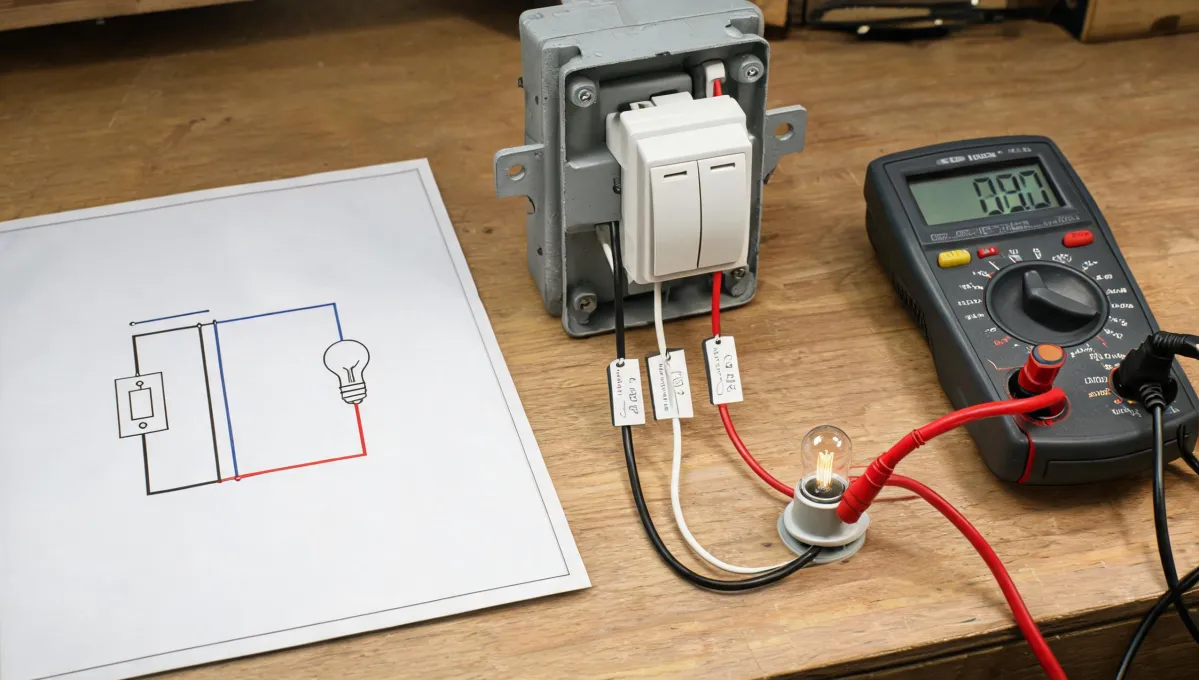
Two months ago, a panel OEM customer ordered 600 units of "Leviton switch and tamper resistant outlet" for a control panel line they were assembling. The pallets arrived on time. The boxes were labeled correctly. The brand markings were right. And then the electrical inspector failed the entire batch because the receptacles were rated for 15 amps — the panel circuits were designed for 20.
The customer was angry at the supplier. But here's the uncomfortable truth: the supplier shipped what the purchase order said. And the purchase order said "Leviton switch and tamper resistant outlet" — which is not a specification. It's a category.
A category is not a specification. Put another way: if the vendor has to guess, the order is already wrong.
I'm a quality compliance manager at an electrical distributor. I review every switch and outlet order that goes through our facility — roughly 200 line items a year. In 2024, I rejected 7% of first-round supplier deliveries for spec mismatches. That number would be higher if it included the orders that failed after reaching the customer.
I see this pattern constantly. Not because buyers are careless — most of them are genuinely trying to get it right. The problem is that the language in their BOMs and purchase orders doesn't mean what they think it means.
Three Reasons Orders Like This Fail
1. "Leviton switch and outlet" is a product family, not a part number
Leviton manufactures dozens of switch lines: Decora, standard toggle, commercial specification grade, industrial heavy-duty, combination devices, dimmers, and more. Within each line, you specify pole count, amperage, voltage, termination style, and features like pilot lights or power indicators. When you write "Leviton switch and outlet" on an order, you're asking the vendor to guess. Vendors are good at guessing — they do it hundreds of times a day — but a guess is still a guess.
Why does this happen? Because retail and wholesale are different games. In a retail aisle, "Leviton switch" gets you a curated product that works for a typical home. In a wholesale order, that phrase goes into a fulfillment system that doesn't know what you meant. It knows what you wrote.
When I compared two customer orders side by side — same vendor, different specification detail — I finally understood why catalog numbers matter so much. The specified order cleared inspection on the first visit. The other took three weeks and two rejected batches. The price difference between them was negligible. The inspection outcome was not.
2. Tamper-resistant is a code question, not a feature preference
The line I see most often on rejected orders is "Leviton switch and tamper resistant outlet." It sounds thorough. It sounds like someone thought about safety. But tamper-resistant — TR — is not a quality upgrade. It's a code requirement tied to the occupancy of the space where the receptacle is installed.
According to NFPA 70, the National Electrical Code, Article 406.12 requires tamper-resistant receptacles in dwelling units, hotel and motel guest rooms, and certain care facilities like child care centers. A light industrial panel line may not trigger the requirement at all. A school or a hospital likely will. If you don't know which one your project is, you're guessing — and the inspector's job is to find exactly that kind of guess.
To be fair, the confusion is legitimate. "Tamper-resistant" sounds like "weather-resistant" or "corrosion-resistant" — an upgrade you add when you want better performance. So buyers either add TR to every line item and eat the cost, or they skip it because they assume commercial means "not required." Both decisions fail when they're driven by assumption instead of code.
3. The panel OEM substitution trap
The third reason is the one that costs real money, and it usually shows up after the order is delivered.
When you hand a BOM to a panel OEM — or source components for a custom control panel shop — you're working with a team that builds enclosures all day, every day. Their job is to get the BOM built and out the door. If your BOM says "Leviton switch and outlet, equivalent to catalog number X," the shop may substitute a component that looks similar but has a different UL file number.
I still kick myself for letting a substitution through in 2022. The switch looked identical. The dimensions matched. The rating matched. But the wiring diagram — the terminal layout on the back of the device — was completely different. The electrician spent a weekend re-terminating forty units. If I'd caught the catalog number discrepancy at the drawing review stage, that weekend wouldn't have happened.
The deeper problem is listing integrity. Industrial control panels are typically covered under UL 508A. When a component inside the panel is substituted, that listing can be compromised. The panel might function perfectly, but the compliance documentation no longer matches the physical hardware. In a commercial project, that's a serious finding. In an insurance claim, it's a potential denial.
This isn't about private-label components being inferior. I've seen private-label devices perform admirably. The question is whether a substitution changes the listing, the wiring, the dimensions, or the performance envelope — and whether anyone approved it in writing.
What Under-Specified Orders Actually Cost
Device-level prices are small. A specification-grade switch costs a few dollars more than a residential-grade device. A tamper-resistant outlet is a dollar or two above a standard one. On a 1,000-unit order, the difference is a rounding error in the project budget. So why do buyers resist specifying to the catalog number? Usually because they think the details can be worked out later. They can't.
The most expensive failure I've witnessed personally was a $22,000 redo. A customer ordered 800 receptacles — maybe 850, I'd have to check the file; the exact count isn't the point — for a tenant improvement project. The BOM said "Leviton outlet, specification grade" — no catalog number. The supplier shipped a mixed batch: part commercial specification grade, part residential grade. The inspector opened a panel, saw two visibly different devices, and rejected the electrical rough-in for inconsistency.
The customer wasn't upset about the difference in device prices. They were upset about 40 hours of electrician labor, a pulled permit, and a rescheduled inspection. That's the real cost of an under-specified order.
Then there's the substitution math. A panel OEM might save $0.40 per device by substituting a comparable component. On a 1,000-unit run, that's $400 in savings. But a single non-compliant panel in a commercial installation can trigger a $50,000 liability — or worse, a voided warranty, a failed audit, or a compliance finding on a project that was supposed to be final.
The surprise wasn't that the substitution happened. It was that the discrepancy had been flagged in a packing list note — and nobody opened that note for four days.
I'll be honest about the panel wholesale cost guide angle: there's no universal price sheet I can give you. Wholesale pricing depends on volume, contract terms, and market timing. What I can tell you is that the cost difference between getting the spec right and getting it wrong is never the device price. It's the labor, the delay, and the compliance risk.
How to Keep This From Happening
The fix isn't complicated, but it requires changing a procurement habit. Here's what I tell every customer who works with us:
Write catalog numbers, not categories. If you want Leviton switches and outlets, open the manufacturer's control panel catalog — or the online cross-reference — and list the catalog numbers for every device. A proper catalog entry shows the catalog number, electrical ratings, NEMA configuration, and UL file number in one place. If you can't find that information, ask the supplier for it before you issue the purchase order, not after.
Stop writing "or equivalent" without a process. In one page of a purchase order, "or equivalent" can turn a compliant panel into a non-compliant one. If a panel OEM wants to substitute, require the substitution to be submitted for approval in writing. That single sentence prevents most of the failures I review.
Confirm the tamper-resistant requirement against the actual occupancy. Ask the project engineer which occupancy classification applies. If it triggers NEC 406.12, verify that the catalog numbers on your order include the tamper-resistant feature — and the correct UL listing to back it up. If it doesn't trigger, you can leave TR off and keep the cost down. Just decide on purpose, not by default.
And buy from a supplier that provides spec guidance, not just order processing. An informed customer asks better questions and makes faster decisions. A supplier who's willing to walk you through the difference between a Decora switch and a toggle switch — or explain why your UL file numbers matter — is worth the transaction. That's not a sales pitch. It's years of watching the same mistake cost people tens of thousands of dollars.
Specs matter. Period.