
-
Step 1: Verify the Certification Record Before You Trust the Product Page
-
Step 2: Buy by Catalog Number, Not by Product Name
-
Step 3: Ask for the Wiring Diagram Before You Order a Combo Device
-
Step 4: Read the Control Panel Specification Sheet Like Your Electrician Would
-
Step 5: Run a Small Trial Order and Watch What Happens
-
Step 6: Verify Invoicing and Documentation Before You Need Them
-
Common Mistakes I Still See in Switch Supplier Evaluations
I'm not an electrician, and that's probably true for a lot of people who end up responsible for buying electrical devices at work. I'm the office administrator at a 260-person engineering-support company across three locations. Since I took over purchasing in 2020, I've processed somewhere between 60 and 80 orders a year across eight approved vendors. The electrical portion of that is not the biggest line item in our budget, but it's the one that can cause the most chaos when it goes wrong.
When I'm evaluating a switch manufacturer or a wholesale supplier who carries Leviton products, I put every new vendor through the same sequence. It's six steps, and I don't skip any of them—not for a $200 order, and not for a $20,000 one. The steps are about protecting my internal customers, my facilities team, and my own reputation with the finance department.
Step 1: Verify the Certification Record Before You Trust the Product Page
Every supplier can write the words “UL Listed” on a product page. The difference shows up when you ask them to back it up. If a vendor hesitates to provide a certification number or a listing reference, I treat that as a red flag.
I don't need to know every UL standard by heart, but I do need to know the basics. A typical wall switch is tested to UL 20, the standard for general-use snap switches. Receptacles, including tamper-resistant versions, fall under the coverage of UL 498 for attachment plugs and receptacles. If you're buying a combination device, the certification should cover the complete combo unit, not just one function of it.
The actual check takes two minutes. I ask for the listing record and verify it through the public UL Product iQ database at ul.com. That matters more than any logo printed on a box. I also keep in mind the FTC's substantiation principle from its advertising guidance (ftc.gov/business-guidance/advertising-marketing): a claim needs evidence behind it. “UL listed” on a quote is the claim. The listing record is the evidence.
Step 2: Buy by Catalog Number, Not by Product Name
“Leviton switch” is not one product. It's dozens. Single-pole and three-way, 15-amp and 20-amp, illuminated and not, residential and commercial grade, different colors, and different configurations if you're combining a switch with a receptacle or a pilot light. If I order by a vague product name, I'm basically asking the supplier to guess.
That's why the catalog number is the real specification. A proper Leviton switch catalog lets me search by the function I need and confirms the exact catalog number before the quote goes out. When a supplier sends me a quote, I check that every catalog number matches what's actually published on the manufacturer's current spec sheet. It's not about distrust. It's about the fact that identical-looking devices can have completely different wiring configurations inside.
I learned this the hard way in 2021 when I asked a vendor for “twenty-five Leviton switches and outlets for a conference room renovation.” The order arrived quickly. It was also wrong. The devices were real Leviton products, just not the right functions or ratings for the room. The vendor was nice about the return, but I lost a week and annoyed the facilities manager. The catalog number would have prevented all of it.
Step 3: Ask for the Wiring Diagram Before You Order a Combo Device
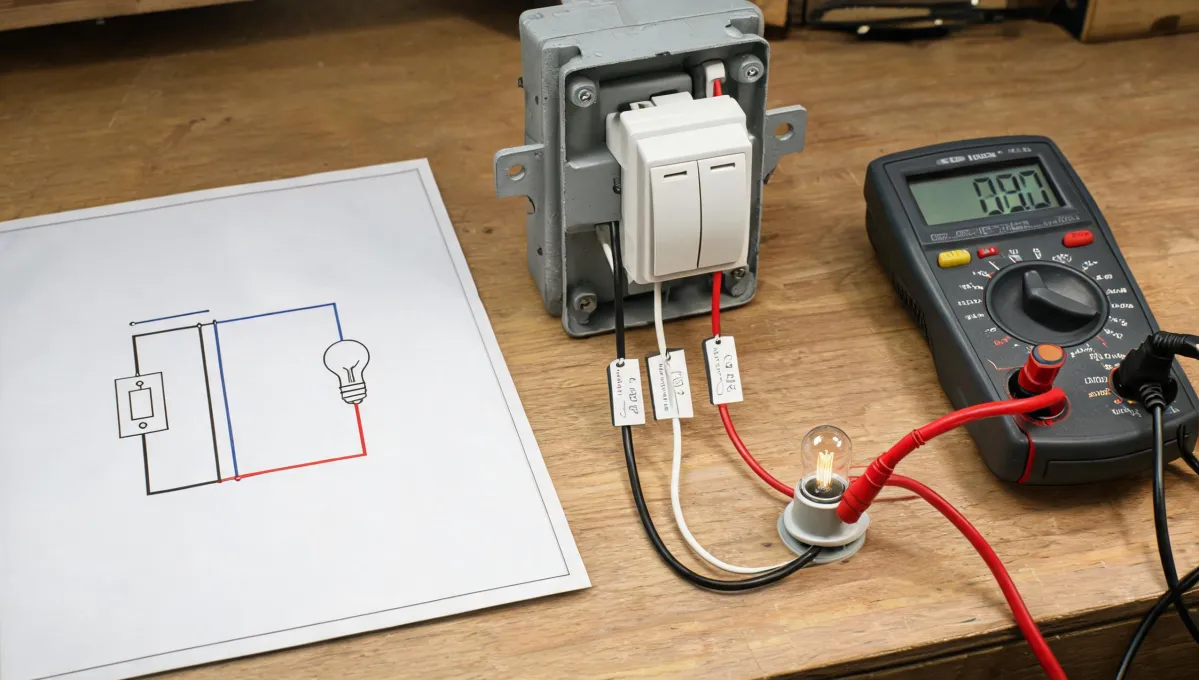
Combination devices are where the “switch outlet combo” part of the conversation gets serious. A Leviton switch and tamper resistant outlet combo is common in commercial spaces where you need one yoke to do two jobs. But the wiring diagram is not a decoration. It tells the installer exactly which terminals are line, load, neutral, and ground, and how the switch interacts with the receptacle.
When I'm evaluating a supplier, I ask for the manufacturer's own Leviton switch outlet combo wiring diagram PDF for the exact catalog number I'm quoting. If they can't produce it for a mainstream combo product, I don't need to wait around to see what happens when I order something more complicated.
A few years ago, I would have assumed that a “switch and outlet” product works the same way regardless of the wiring intent. That's oversimplifying it. One combo device can be wired so the switch controls the receptacle. Another version can keep the receptacle hot all the time while the switch controls a separate light. The diagram is what tells the installing electrician which scenario applies. Suppliers who understand that distinction are usually the ones who also understand control panel documentation.
Step 4: Read the Control Panel Specification Sheet Like Your Electrician Would
Once you move beyond individual devices into control panels and switchgear, the evaluation gets more demanding. I'm not an electrical engineer, so I can't design a panel. But I can insist that the manufacturer or supplier gives me a complete specification sheet.
The spec sheet needs to answer the questions that an electrician or electrical inspector will ask. What's the voltage and current rating? What enclosure type is it? What is the short-circuit current rating, often abbreviated as SCCR? Is there a schematic or wiring diagram with a drawing number and revision date? What components are inside, and what are their catalog numbers? If a quote says “control panel per attached specifications” and there are no attached specifications, that quote is not ready for approval.
I keep coming back to a fairly simple rule: if the supplier can't document it, the supplier can't support it. That's especially true with control panel specifications, because the panel isn't just a box full of switches. It's an assembly, and the certification and ratings belong to the complete assembly, not just the individual parts inside it.
Step 5: Run a Small Trial Order and Watch What Happens
Here's where I may annoy some people: I want a supplier to take a small order seriously. Please hear me out. I'm not saying every distributor needs to accept five-piece orders. Minimum order quantities exist for real business reasons, and I get that. But the way a vendor handles a modest trial order tells me a lot about how they will handle me when something goes wrong.
When I was building our current vendor list in 2023, I placed a small order for Leviton switches and a few tamper-resistant outlet combos. The dollar value wasn't impressive. What impressed me was that the supplier called to confirm the catalog numbers and asked whether the project needed tamper-resistant versions for code compliance. That call probably cost them ten minutes. It saved us from ordering the wrong devices.
Small doesn't mean unimportant. From my seat as a buyer, small orders are how vendor relationships get tested before real money moves. The vendors who treated our modest trial order professionally are the ones I now trust with much larger purchase orders. The ones who made me feel like I was wasting their time didn't make the approved list.
Step 6: Verify Invoicing and Documentation Before You Need Them
This is the least glamorous step, and it's also the one that protects my budget. A vendor who can't provide proper invoicing can cost you money even when the product is perfect. I found that out when a new supplier couldn't produce a proper commercial invoice for a batch of electrical devices. The handwritten receipt they sent instead didn't pass our accounting review. That vendor ended up costing us roughly $2,400 in rejected expenses before we cut them out of the rotation.
Now, before I add any new switch manufacturer or supplier to our system, I verify their paperwork capability. I ask for a sample invoice, confirm they can reference our purchase order number, and make sure their billing entity matches their legal entity. It's not exciting. It's necessary.
Once that's done, the whole ordering process gets faster. In our 2024 vendor consolidation project, we reduced the time our team spends on facilities purchasing from about six hours a month to under ninety minutes. A big part of that was simply knowing which suppliers could handle the documentation without follow-up calls.
Common Mistakes I Still See in Switch Supplier Evaluations
After five years of managing these relationships, I've noticed the same errors show up again and again:
- Comparing unit prices without comparing total cost. Shipping, minimum order requirements, and restocking policies can turn a “cheap” order into an expensive one.
- Trusting compatibility claims. If a supplier says a device “works with everything” or “meets all codes,” that's a warning sign. Electrical products need verifiable ratings, not vague promises.
- Ordering by description instead of catalog number. Product names don't distinguish between single-pole and three-way, 15-amp and 20-amp, or TR and non-TR versions.
- Skipping the trial order. The most expensive mistakes happen when you hand a large purchase order to a vendor you've never tested.
To me, the best suppliers are almost boring about details. They send clean spec sheets, they know their catalog numbers, they produce wiring diagrams without a struggle, and they don't flinch when your first order is small. That consistency is the whole game.
The supplier who treats a modest order with the same care as a major one is the supplier who will help you look good when something goes wrong. That's the standard I use for every Leviton switch order I place.