
Every week, I hear the same three questions in slightly different wording:
“A shipment of Leviton switches and tamper-resistant outlets just landed. What do we check before sending them out?”
“I'm qualifying a switchgear OEM and circuit breaker supplier for our panel line. What actually matters besides unit price?”
“Can you give us a fuse specification guide that stops maintenance from buying the wrong thing?”
They read like three different articles. In my role as a quality and brand compliance manager at an electrical supply company, I review roughly 200+ product lines a year. I rejected about 12% of first deliveries in 2024, mostly for marking errors, documentation gaps, or failures that only showed up in sample testing. Four years ago, I would have handed everyone the same generic supplier checklist. I don't anymore. The failure modes are different, so the checklist has to be different.
The scenario determines the answer. Here's how I break it down.
Scenario 1: Buying Leviton switches and tamper-resistant outlets in volume
This is the most common one. A distributor, a contractor with a multifamily project, or a procurement team needs a few thousand wiring devices. The product is already engineered. Your job is to verify that what arrives is what was ordered, from a supply chain you can defend.
Start with the source. If your purchase order mixes a Leviton switch with a tamper resistant outlet, or includes combination switch/receptacle devices, the way I verify them is the same: ask the supplier to prove the stock came through an authorized channel. Counterfeit wiring devices still circulate, and the packaging is sometimes better than the product inside. A price that is 15% below everyone else is not a bargain. It is a red flag.
Then do a physical check:
- Check markings on the device, not just the box. Date codes, UL/CSA marks, and catalog numbers should match the packaging. If the box says one thing and the molded body says another, stop.
- Check a sample from every lot. On a Leviton switch, the toggle action should feel clean and consistent. Terminals should be uniform. Devices from different production runs should not look noticeably different side by side.
- Test tamper-resistant receptacles properly. Since the 2008 National Electrical Code, tamper-resistant receptacles have been required in dwelling-unit locations under Article 406.12. The internal shutter is the whole point. Take five or six outlets from the lot and insert a single small object into one slot. The shutter should block it. If a single slot opens, the device fails. We quarantine the whole lot.
I learned that lesson the hard way. In Q1 2024, we sampled a 500-piece lot of Leviton TR outlets. Packaging was immaculate, markings looked correct, and the first three samples passed. The fourth didn't. The shutter opened with a paper clip. We quarantined the lot and sent it back. The vendor replaced it at their cost, but it cost us three weeks and a very annoyed customer.
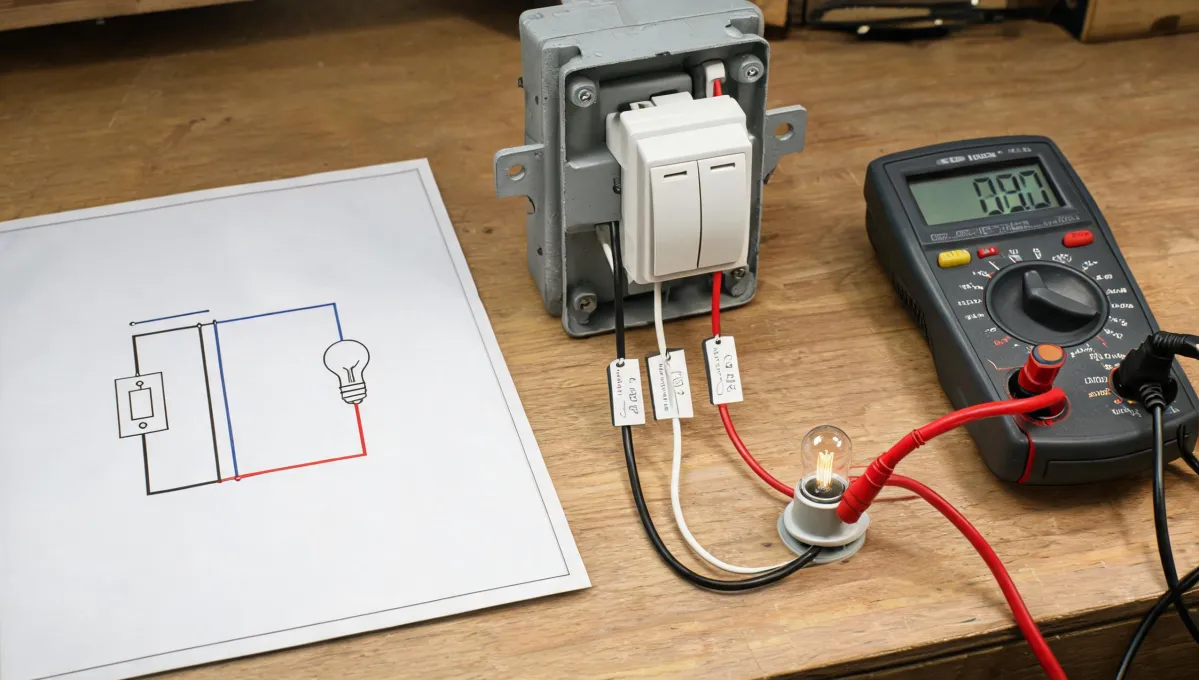
One more thing about combination devices. Searches for “leviton switch outlet combo wiring diagram” are common, and I understand why. A switch/receptacle combo looks straightforward until you realize that the wiring depends on the exact catalog number and product generation. A generic diagram found online may not match the device in your hand. When you source at volume, request the manufacturer spec sheet for the exact SKU. If the supplier sends a generic image instead of a model-specific diagram, that tells you something about how carefully they know their own inventory.
This works for us, but our context is fairly stable domestic wholesale ordering. If you are dealing with grey-market imports or a vendor you cannot audit, the calculus changes. I can only speak to what we verify before products reach our customers.
Scenario 2: Qualifying a switchgear OEM and circuit breaker supplier
This is a different game. If you are building panels or equipment under your own label, you are not just buying components. You are buying documentation and traceability that will follow the equipment for decades.
The first thing I ask a circuit breaker supplier is simple: “Is this a UL 489 listed breaker or a UL 1077 supplementary protector?” Both are legitimate products. They are not interchangeable. A UL 489 breaker is intended for branch-circuit overcurrent protection. A UL 1077 supplementary protector is not a substitute. If that distinction gets missed, it usually surfaces during inspection, which is the most expensive time to discover it.
I used to assume that “same specifications” meant identical results across vendors. I don't anymore. Two suppliers can both quote a 100-amp breaker, and each may interpret the requirement differently. One quotation includes a full UL file number, trip curve, interrupting rating, and terminal details. The other is a line item with a price. Those are not the same offer.
When you are sourcing switchgear as an OEM, ask what standard the equipment is built to. There is a meaningful difference between a UL 891 switchboard and UL 1558 low-voltage switchgear. Both can be safe. But if your project specification assumes one and the supplier delivers the other, that is a compliance problem, not a paperwork nuance.
I also check what the quote does not say. On breaker orders, the hidden extras are usually freight minimums, partial shipment fees, documentation charges, and restocking terms. I have learned to ask “what's NOT included” before “what's the price.” The supplier who lists all fees upfront, even if the total looks higher, usually costs less in the end.
If a quotation lists breakers by exact catalog number, includes the relevant UL file references, and answers the SCCR question without hedging, that is worth paying for. Not because the breaker is different, but because someone on the supplier side is doing their job. That reduces your risk of a rejected panel and a delayed shipment.
This is also where I recommend verifying listing status through UL's Product iQ database. It takes two minutes. It has caught more than one “equivalent” product that turned out not to be listed for the intended application.
Scenario 3: Fuse specification guide for replacement and spares
I have lost count of how many times someone has said, “I just need a 30-amp fuse.”
Okay. But what class? What voltage rating? What interrupting rating? Time-delay or fast-acting? The ampere rating is one line of a real specification, not the whole specification.
Fuses are a maintenance blind spot because a lot of them look similar. If your team is replacing fuses based only on the amp stamp, you are guessing. A good fuse specification guide includes at least these:
- Class. Class CC, J, RK1, RK5, and others have different physical dimensions, rejection features, and performance characteristics. They are not interchangeable.
- Speed. Time-delay fuses tolerate motor inrush. Fast-acting fuses protect sensitive electronic circuits. Swapping one for the other causes either nuisance trips or inadequate protection.
- Voltage rating. A fuse rated for 250 volts does not belong in a 600-volt circuit, even if it fits.
- Interrupting rating. This is the one people skip. Two fuses can both say 30 amps. One may interrupt only 10,000 amps, while another is rated for 200,000 amps. If a fault exceeds the interrupting rating, the fuse can rupture violently.
The words “or equivalent” on a maintenance requisition are dangerous unless someone defines what equivalent means. I have seen a buyer substitute a fast-acting fuse for a time-delay fuse because both were “30 amp.” The equipment started up fine for a month. Then it didn't start at all, and the electrical room smelled like a lesson.
I am not an engineer, and I am not going to pretend to do coordination studies. What I can say from a quality perspective is that the label on the old fuse is the starting point of the specification, not the whole specification. Replace the class, speed, voltage rating, and interrupting rating together, not just the ampere stamp.
How to know which scenario you're in
If you are not sure which set of checks applies to you, ask yourself these three questions:
- Will these products be installed directly into a building or project? If yes, you are in Scenario 1. Verify source, markings, and sample function. This is especially important when you are buying Leviton switches, outlets, and combination devices for resale or large installations.
- Will these components become part of equipment that you build, label, or sell? Then you are in Scenario 2. Documentation, listing classifications, and traceability matter more than the unit price of a breaker.
- Are you maintaining existing electrical systems and replacing components that are already installed? Scenario 3. Start with the label on the existing fuse or breaker and build a complete specification from it.
If you fit more than one scenario, run more than one checklist. A contractor who stocks spare fuses for the buildings they service is in both Scenario 1 and Scenario 3. A panel builder who also replaces breakers in the field is in all three.
No matter which scenario you are in, the common thread is verification. Compare prices, sure, but compare specifications first. The extra ten minutes spent checking documentation before an order ships costs very little. The 8,000-unit lot installed with the wrong component costs a lot.
There is something satisfying about a job where the shipment passes, the panel is accepted, and nothing catches fire. Honestly, an uneventful Tuesday is the best outcome I can hope for in this line of work. The goal is to keep your projects quiet.